
Most law firms assume profitability problems begin with client acquisition. More clients. More cases. More…
Your Competitors Checked Their Dashboard 25 Times This Month
Law firms are replacing month-end reports with real-time financial dashboards — and the ones doing it first are pulling ahead on profitability, collections, and partner confidence. Here’s what they know that you might not.
38%Avg utilization rate
88%Avg realization rate
93 days Median total lockup
80%Dashboard usage growth H2 2025
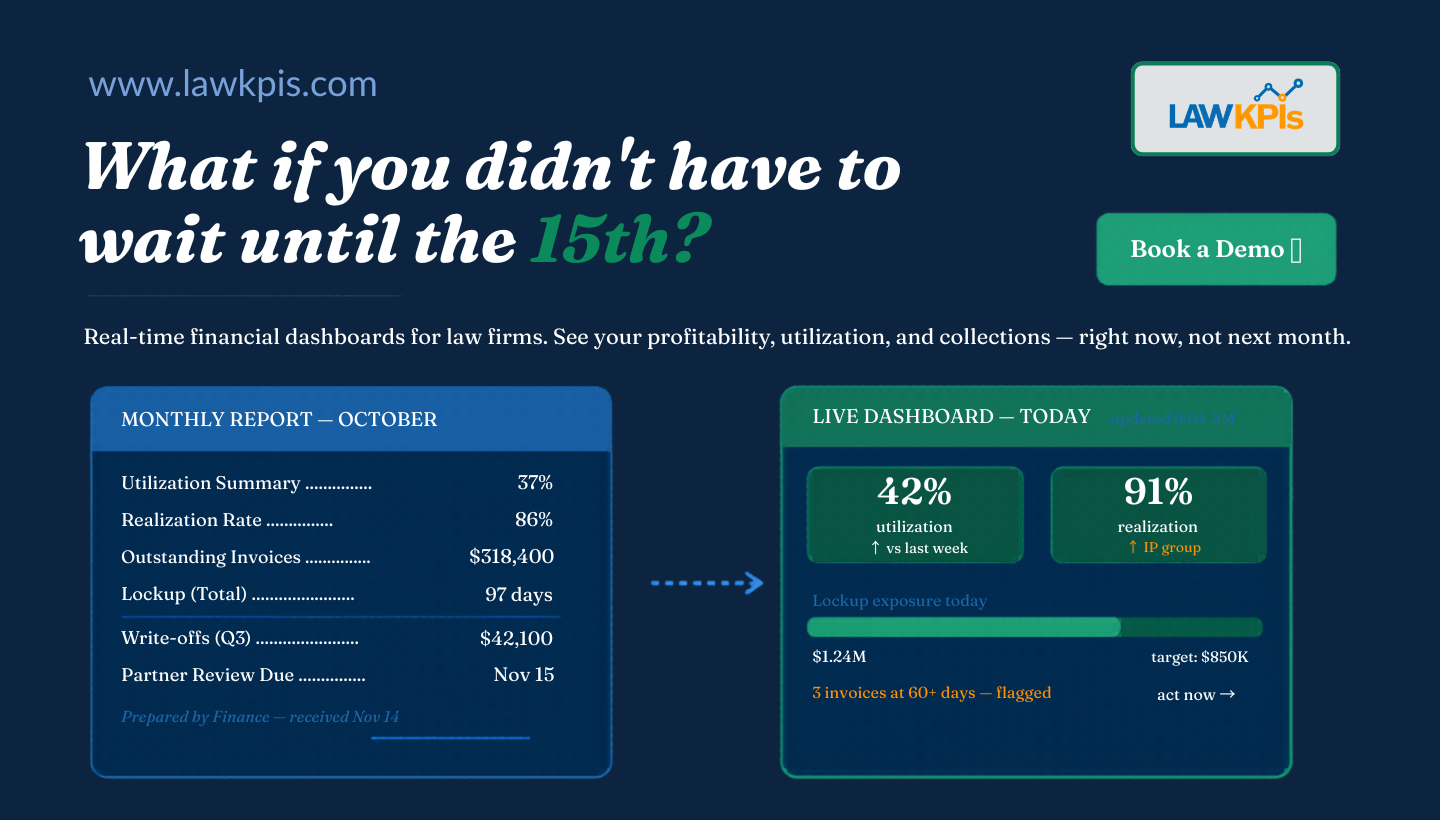
It’s the 15th of the month. Your financial report finally lands in your inbox. You open it, scan the numbers — and feel that familiar, slow-burn frustration. You’re looking at October. It’s November. One of your top associates has been running at 29% utilization for six weeks. A major client has three invoices outstanding at 60-plus days. A practice group you thought was performing has been quietly writing off 14% of its billable work all quarter.
You didn’t know any of this. You couldn’t. Because your firm’s financial data was locked inside a reporting cycle that delivers information two to four weeks after the moment it was useful.
This is not a technology problem. It is a visibility problem. And it is costing law firms — firms exactly like yours — hundreds of thousands of dollars per year in unrecovered revenue, missed interventions, and decisions made on stale data.
The firms pulling ahead right now are not working harder. They are seeing clearer. They have replaced the month-end report with a real-time law firm financial dashboard — and the difference it makes to how they operate is not incremental. It is fundamental.
The true cost of delayed visibility
Let’s talk about what delayed financial data actually costs a law firm, in concrete terms.
According to the Clio Legal Trends Report 2025, the average attorney utilization rate across law firms is 38% — meaning lawyers capture just 3.0 billable hours in a standard eight-hour day. That gap between available time and captured revenue is not random. It compounds. It hides in late time entries, administrative interruptions, and fragmented days. And in most firms, nobody sees it until the monthly report arrives.
Raise one attorney’s utilization from 37% to 50%, and you add approximately 260 billable hours per year. At $300 per hour, that is $78,000 in additional revenue from a single timekeeper. Multiply that across a 20-attorney firm, and you are looking at a seven-figure revenue recovery — hiding inside a metric that most managing partners check once a month.
“A 5% improvement in realization can equal a 20% improvement in profitability. That’s worth the effort — and the only way to achieve it is to see where the leak is happening, in real time.”.
Realization tells an equally important story. The industry average sits at 88% firm-wide — but that aggregate masks enormous variation by practice area. IP practices typically realize at 93%. Criminal defense can drop to 75%. If you are looking at a single firm-wide number, you are missing an 18-point gap between your best and worst-performing practice groups. You cannot fix what you cannot see broken down.
And then there is lockup. The median total lockup for law firms in 2025 is 93 days — a combination of 43 days in unbilled work-in-progress and 32 days in unpaid invoices. For a $5M revenue firm, that is approximately $1.27 million in earned revenue sitting in limbo at any given moment. That is the capital you are using borrowed cash to cover. That is the number your real-time law firm KPI dashboard should be showing you every Monday morning — not every 15th.
What a real-time law firm financial dashboard actually shows you
The conversation about law firm real-time reporting often gets lost in abstraction. So let’s be specific about what your managing partner dashboard should surface — and what most firms are currently flying blind on.
-
Utilization by attorney, by week, by role. Not a firm-wide average. Individual visibility, so you can see who is underloaded, who is over-capacity, and where work should be redistributed — before the month closes.
-
Realization rate by practice area and matter type. The firm-wide 88% means nothing without the practice-area breakdown. Your dashboard should show you which groups are discounting, writing off, or losing billing discipline — and flag it in real time.
-
WIP aging and invoice aging by client and partner. Every invoice over 30 days should be visible, sortable, and assigned to an owner. The managing partner who can see that Client X has three invoices at 60-plus days can intervene in a relationship context — not a collections crisis.
-
Total lockup, broken down by realization lockup and collection lockup. Two separate leaks, two separate interventions. Seeing them together in a single view gives you a complete picture of your firm’s cash flow exposure at any moment.
-
Matter-level profitability under any billing model. As flat fees and alternative fee arrangements become more common, the billable hour is no longer the only unit of profitability measurement. Your dashboard needs to show you whether each matter is profitable — regardless of how it is billed.
This is not a wish list. These are the law firm profitability metrics that the highest-performing firms in your market are already reviewing daily. The technology to surface them clearly and in real time exists today.
The firms pulling ahead are already doing this
The behavioral shift is documented. According to Legal Practice Intelligence, law firm dashboard usage at analytics-enabled firms grew by nearly 80% in the second half of 2025 — with the average managing partner accessing their dashboard 25 times per month, compared to 14 times just six months earlier. That is not a trend. That is a habit forming.
The firms building this habit are not all large. They are not all AmLaw 200. They are mid-market firms — 15, 30, 60 attorneys — who made a deliberate decision to stop managing by the monthly PDF and start leading by the live number. The result is not just better data. It is a fundamentally different posture: from reactive to anticipatory, from reporting to managing.
The Clio Legal Trends Report 2025 makes the competitive dynamic explicit: growing firms leverage analytics technologies nearly three times more than shrinking firms. The correlation between financial visibility and firm growth is not a coincidence. It is the mechanism.
The switch is simpler than you think
The most common reason law firms delay this transition is not cost. It is the assumption that implementation requires months of IT work, data migration, and organizational change. That assumption is outdated.
Modern legal analytics software connects to your existing practice management system — Clio, MyCase, PracticePanther, and others — and visualizes your data in a structured, role-specific dashboard within days, not months. Your managing partner sees firm-wide performance. Practice group leaders see their group. Individual timekeepers see their own metrics. No single point of comparison. No political friction. Just clarity.
The managing partners who have made this shift consistently report the same experience: not that the numbers changed, but that they finally understood what the numbers were telling them — in time to do something about it.
What if you didn’t have to wait until the 15th? What if every Monday morning started with a complete, accurate picture of your firm’s financial health — utilization by attorney, realization by practice group, lockup by client, collections by risk level — before your first partner call?
That is not the future of law firm management. It is what the firms winning today already have.
See what a live law firm financial dashboard looks like. We’ll show you exactly the metrics covered in this article — built around your firm’s data, not a demo template. No commitment required.
Book a 20-Minute Demo → https://go.lawkpis.com/book-a-demo/

Related Posts