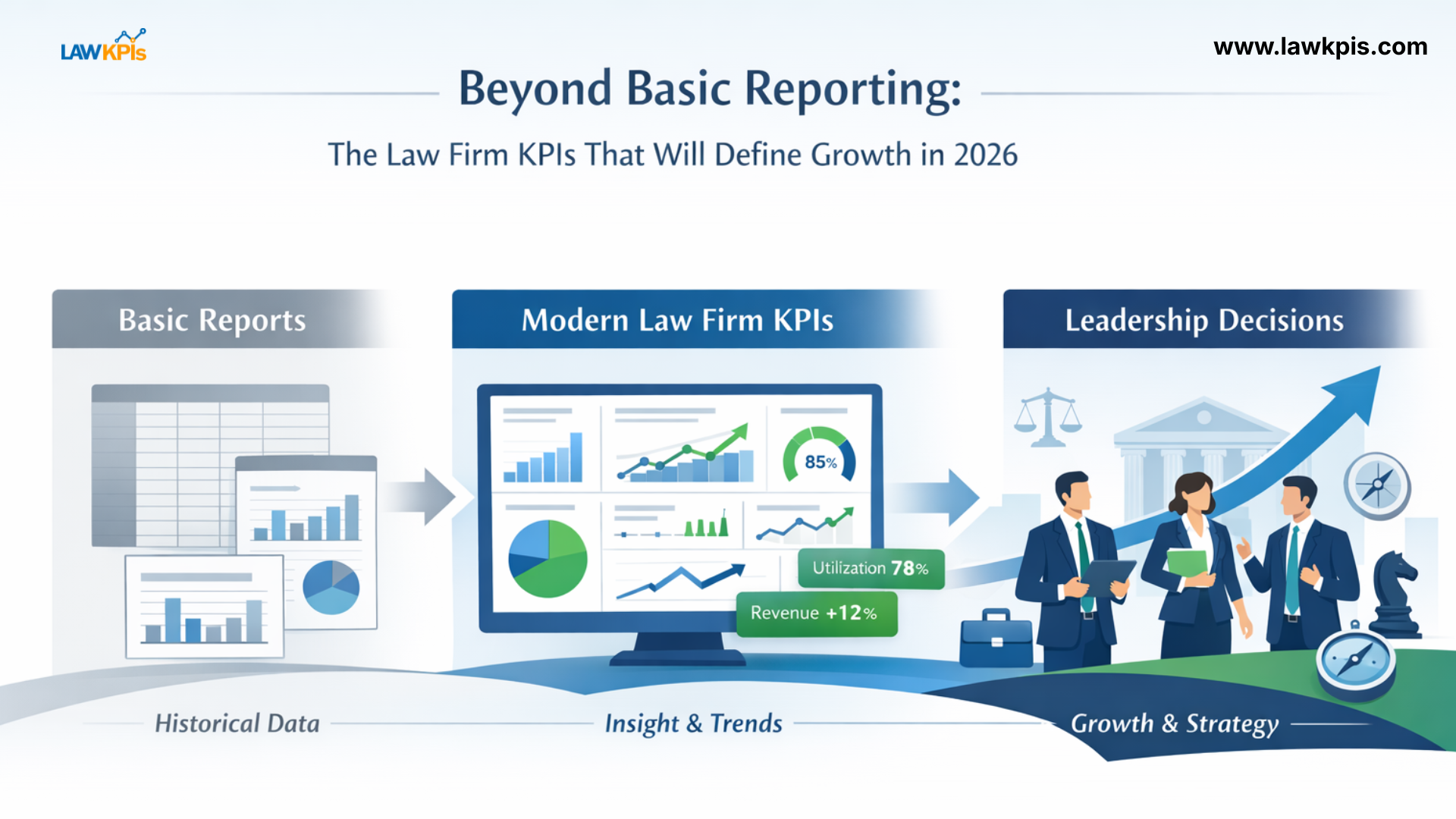
Law firms often assume that busy attorneys mean a healthy business. Attorneys track billable hours,…

Law Firm Financial Metrics Explained
Law Firm Financial Metrics Explained
Most managing partners don’t have a data problem. They have a clarity problem.
Law firms track revenue, billable hours, collections, and expenses — yet many leaders still struggle to answer a simple question:
Is the firm actually profitable, or just busy?
This is where law firm financial metrics become critical. When understood correctly, these metrics help managing partners move from reviewing reports to making confident, data-driven decisions.
This guide explains the most important law firm financial metrics in plain English, so you can clearly understand what drives performance, profitability, and growth.
What Are Law Firm Financial Metrics?
Law firm financial metrics are measurable indicators that show how your firm is performing financially.
More importantly:
They are decision-making tools, not just reports.
They help answer questions like:
-
Are we truly profitable?
-
Are our lawyers working efficiently?
-
Are we capturing the full value of our work?
-
Where is revenue leaking?
When these metrics are connected and understood together, they provide a complete picture of firm performance.
The 7 Most Important Law Firm Financial Metrics
Most firms track dozens of numbers — but only a few actually drive decisions.
Here are the 7 most important law firm financial metrics explained simply.
1. Revenue (Law Firm Revenue Metric)
What it is: Total income generated by the firm
Shows how much money is coming in
Key insight: Revenue growth does not always mean profitability
2. Net Profit Margin (Law Firm Profitability Metric)
What it is: Percentage of revenue remaining after expenses
How much the firm actually keeps
Why it matters: This is your true financial health indicator
3. Revenue per Lawyer
What it is: Revenue divided by number of lawyers
How much each lawyer contributes
Why it matters: Measures efficiency and team productivity
4. Utilization Rate
What it is: Percentage of time spent on billable work
How much time lawyers spend earning money
Important: Measures productivity — not profitability
5. Realization Rate
What it is: Percentage of work that becomes billed and paid
How much work turns into revenue
Key insight: This is where many firms lose money without realizing it.
6. Collection Rate
What it is: Percentage of invoices paid
How much billed money you actually received
Why it matters: Directly impacts cash flow
7. Accounts Receivable (AR)
What it is: Outstanding client payments
Money you’ve earned but not yet received
Why it matters: High AR slows growth and creates financial pressure
Why Law Firms Struggle with Financial Metrics
Most law firms already track these metrics. The problem is not lack of data — it’s lack of clarity.
Metrics are often:
-
reviewed in isolation
-
buried in spreadsheets
-
disconnected across systems
-
difficult to interpret
This leads to assumptions such as:
-
“We’re busy, so we must be doing well.”
-
“Revenue is growing, so profitability is improving.”
These assumptions often hide revenue leakage and inefficiencies.
How Law Firm Financial Metrics Work Together
A single metric rarely tells the full story. Real insight comes from how metrics interact.
For example:
-
High utilization + low realization → Work isn’t converting into revenue
-
High revenue + low profit margin → Costs are too high
-
Strong billing + weak collections → Cash flow issues
Managing partners need connected metrics, not isolated reports.
What High-Performing Law Firms Do Differently
Top-performing firms don’t just track financial metrics. They connect them to decisions.
They analyze:
-
productivity + profitability
-
billing + collections
-
revenue + cost structure
This helps identify:
-
Which lawyers are truly profitable
-
which practice areas underperform
-
where revenue is leaking
-
what actions to take
What Is a Law Firm Financial Dashboard?
A law firm financial dashboard is a centralized system displaying key financial metrics in real time, replacing fragmented reports with a single source of truth.
-
track utilization and realization together
-
monitor profitability trends
-
identify revenue leakage
-
compare lawyers and practice areas
-
make faster, data-driven decisions
A financial dashboard turns data into clear, actionable insight.
Why Managing Partners Need a Financial Dashboard
Traditional reporting methods — spreadsheets and exports — create limitations:
-
manual effort
-
delayed insights
-
no trend visibility
-
inconsistent data
A financial dashboard for managing partners solves this by providing:
-
real-time visibility
-
connected metrics
-
visual insights
-
decision-ready data
This is why modern firms are shifting toward law firm KPI dashboards.
What Financial Metrics Should Managing Partners Track Weekly?
Instead of reviewing dozens of reports, focus on what matters most.
Weekly (Operational Signals)
-
utilization rate
-
realization rate
-
billed vs collected revenue
-
unbilled work
Monthly (Decision Metrics)
-
revenue per lawyer
-
profit margin
-
collection trends
-
write-downs
This creates a consistent rhythm for performance management and decision-making.
FAQ: Law Firm Financial Metrics
What are the most important financial metrics for law firms?
The most important metrics include revenue, profit margin, utilization rate, realization rate, collection rate, and revenue per lawyer.
Why do law firms struggle with financial metrics?
Because metrics are often disconnected, making it difficult to understand how they impact overall performance.
What is a law firm financial dashboard?
A law firm financial dashboard is a centralized tool that displays financial metrics in real time, helping managing partners monitor performance and profitability.
How often should managing partners review financial metrics?
Weekly for operational insights and monthly for strategic decisions.
Why are dashboards better than spreadsheets?
Dashboards provide real-time data, trend visibility, and connected insights, unlike static spreadsheets.
See Your Law Firm Financial Metrics Live
Understanding financial metrics is important — but managing partners need real-time visibility into performance.
Modern law firms use financial dashboards to:
-
track profitability
-
identify revenue leakage
-
monitor utilization and realization
-
make faster decisions
See your law firm financial dashboard in action.
https://go.lawkpis.com/book-a-demo/

Related Posts