Law Firm Financial Metrics Explained Most managing partners don’t have a data problem. They have…
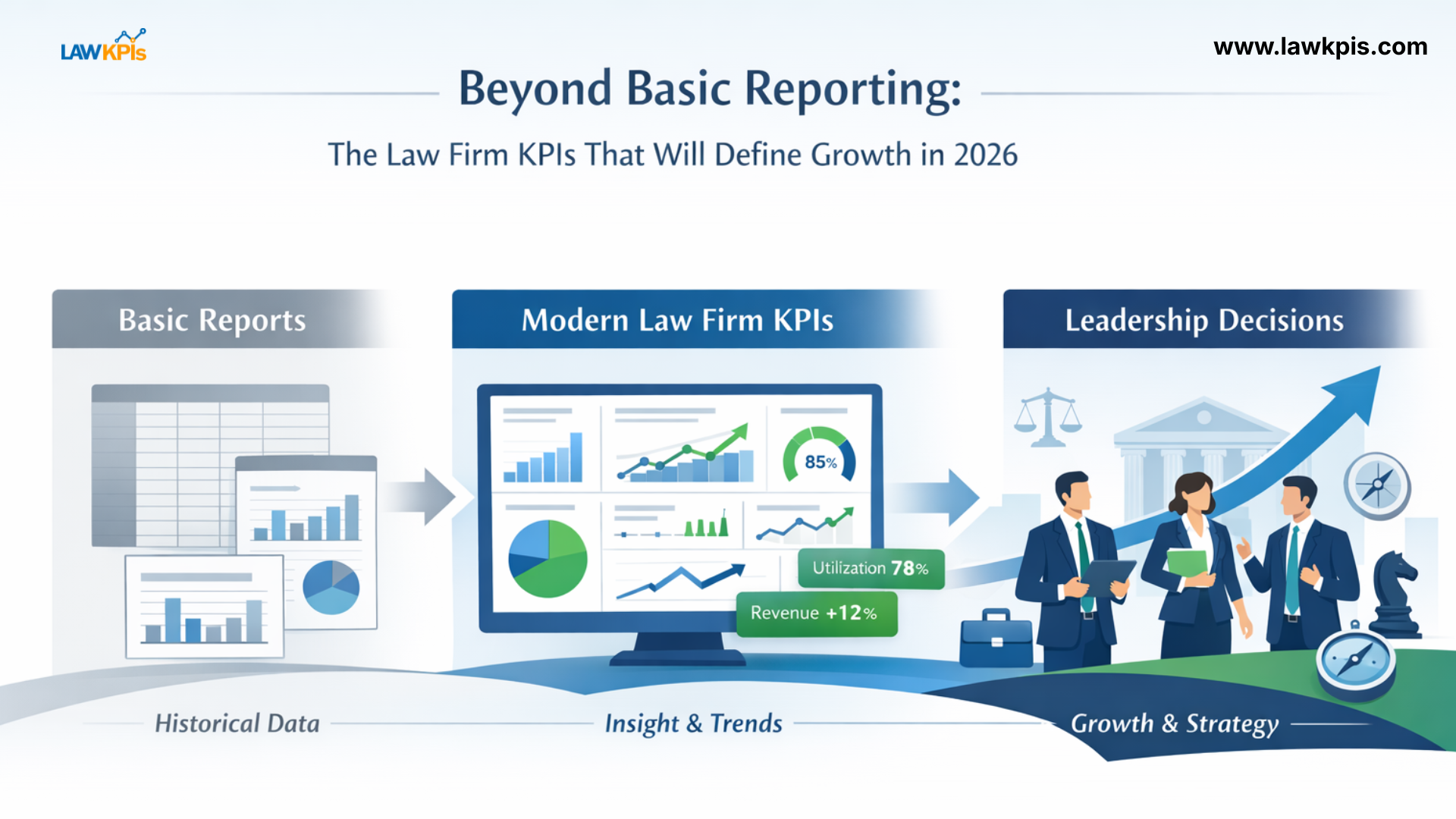
Beyond Basic Reporting: The Law Firm KPIs That Will Define Growth in 2026
In 2026, law firms will not struggle because they lack data.
They will struggle because they lack direction.
Most firms already use practice management systems and generate reports every month. But reports alone do not tell leadership what to do next.
This is why modern Law Firm KPIs matter.
They turn information into insight.
And insight into decisions.
Basic reports show what already happened.
Modern Law Firm KPIs show what is happening now — and what is likely to happen next.
If your KPI process still requires exporting spreadsheets, you are not tracking performance.
You are managing history.
Why Law Firm KPIs Matter More Than Basic Reports
Default reports answer questions like:
-
How much revenue did we bill last month?
-
How many matters were opened?
-
What is outstanding AR?
But leadership questions sound different:
-
Which work is profitable?
-
Which clients drain resources?
-
Where is growth coming from?
-
Where is risk quietly building?
Basic LMS reports are backward-looking.
Modern law firm performance metrics are forward-looking.
They focus on:
-
Trends, not just totals
-
Benchmarks, not isolated numbers
-
Leading indicators, not lagging ones
A firm can grow revenue and still shrink profit.
Without modern Law Firm KPIs, leadership won’t see the danger until it’s too late.
The 10 Most Important Modern Law Firm KPIs in 2026
These are not accounting metrics.
They are leadership metrics.
Each one answers a strategic question about the firm’s health.
1. Revenue per Lawyer
Measures scalability and productivity.
A declining trend signals inefficiency.
2. Net Profit Margin
Shows whether growth is sustainable or cosmetic.
If it declines, costs are rising faster than revenue.
3. Utilization Rate
How much available time is spent on billable work.
Reveals staffing and workload balance.
4. Realization Rate
How much of worked time actually becomes billed revenue.
Utilization = effort.
Realization = value.
High utilization with low realization means wasted effort, write-downs, and poor scoping.
5. Collection Rate
Shows whether billed work turns into cash.
Declines lead directly to cash flow stress.
6. Cash Flow Velocity
How quickly money moves from work performed to money in the bank.
Predicts liquidity and growth capacity.
7. Client Acquisition Cost (CAC)
Marketing and sales spend divided by new clients.
Reveals whether growth is profitable.
8. Marketing ROI
Shows which channels truly drive revenue, not just leads.
9. Case Cycle Time
Time from case opening to closing.
Shorter cycles improve capacity, cash flow, and reveal workflow bottlenecks.
10. Net Income per Partner
Reflects the firm’s true financial health.
If it declines, growth may be masking inefficiency.
These are the law firm profitability metrics that actually predict growth.
Which Law Firm KPIs Actually Predict Growth?
Revenue alone does not predict growth.
The strongest growth indicators are:
-
Net profit margin
-
Revenue per lawyer
-
Cash flow velocity
-
Client acquisition cost
-
Net income per partner
A firm can look successful on paper and still be financially fragile.
Modern Law Firm KPIs expose this early.
How Managing Partners Should Track Law Firm KPIs Monthly
Managing partners should not review dozens of metrics.
They need decision dashboards, not accounting reports.
Monthly Executive KPIs
-
Revenue per lawyer
-
Net profit margin
-
Cash flow velocity
-
Net income per partner
-
Client acquisition cost
Weekly Operational Signals
-
Utilization rate
-
Realization rate
-
Collection rate
-
Case cycle time
If Law Firm KPIs are only reviewed annually, leadership reacts too late.
Monthly and weekly visibility creates proactive leadership.
Utilization vs Realization: The Practical Difference
Utilization measures effort.
Realization measures value.
If an attorney works 40 billable hours but only 32 are billed, realization drops.
High utilization with low realization indicates:
-
Write-downs
-
Inefficient workflows
-
Poor case scoping
-
Client friction
Both must be tracked together to understand true performance.
Why Basic LMS Reports Are Not Enough for Leadership Decisions
Practice management systems are built to run matters.
Not to run firms.
They answer: What happened?
Leadership needs to know:
-
Why did it happen?
-
What is changing?
-
What should we fix next?
Basic reports lack trend analysis, benchmarking, and predictive insight.
Modern Law Firm KPIs connect financial performance, productivity, marketing, growth, and risk.
They turn data into direction.
How Modern Firms Benchmark Law Firm KPIs
Benchmarking allows firms to compare:
-
Practice areas
-
Attorneys
-
Time periods
-
Industry norms
This reveals profit leaks, staffing gaps, overloaded teams, and growth opportunities.
Benchmarking turns numbers into strategy.
What Replaces Spreadsheets for KPI Tracking
Spreadsheets create manual work, formula errors, delayed insight, and inconsistent KPIs.
Modern firms use performance intelligence dashboards layered on top of their practice management systems.
-
Sync automatically
-
Track KPIs in real time
-
Show trends visually
-
Centralize metrics
-
Eliminate manual reporting
They replace spreadsheets with clarity.
The Future of Law Firm KPIs
In 2026, successful firms will not track more data.
They will track better Law Firm KPIs.
They will review performance monthly, benchmark continuously, act earlier, and grow smarter.
Because leadership is not about knowing more.
It is about knowing what matters.
Final Thought: The New Role of Law Firm KPIs
Law Firm KPIs are no longer accounting artifacts.
They are leadership instruments.
The firms that thrive will be the ones that:
-
Track the right metrics
-
Review them consistently
-
Benchmark intelligently
-
Make decisions early
Because the future of law firm management is not about working harder. It is about seeing clearly.

Frequently Asked Questions (FAQs)
1. What are Law Firm KPIs and why are they important in 2026?
Law Firm KPIs (Key Performance Indicators) are measurable metrics that show how a law firm is performing financially and operationally. In 2026, they are critical because they help leadership move beyond basic reporting and make data-driven decisions about profitability, efficiency, and sustainable growth. Unlike static reports, modern Law Firm KPIs reveal trends, risks, and opportunities early.
2. What are the most important Law Firm KPIs to track for profitability?
The most important Law Firm KPIs for profitability include revenue per lawyer, net profit margin, utilization rate, realization rate, collection rate, cash flow velocity, client acquisition cost, marketing ROI, case cycle time, and net income per partner. These law firm profitability metrics provide a complete view of how effectively the firm turns work into revenue and profit.
3. How often should managing partners review Law Firm KPIs?
Managing partners should review Law Firm KPIs on a regular schedule. Core financial KPIs such as revenue per lawyer, net profit margin, cash flow velocity, and net income per partner should be reviewed monthly. Operational KPIs like utilization rate, realization rate, collection rate, and case cycle time should be reviewed weekly to identify issues before they become major problems.
4. Why are basic practice management reports not enough for tracking Law Firm KPIs?
Basic practice management reports focus on what already happened, such as total revenue or total hours worked. They do not provide trend analysis, benchmarking, or predictive insight. Modern Law Firm KPIs connect financial, productivity, and marketing data into a single performance view, helping leadership understand why results are changing and what actions should be taken next.
5. How can law firms track Law Firm KPIs without using spreadsheets?
Law firms can track Law Firm KPIs using performance intelligence dashboards that integrate directly with their practice management systems. These dashboards update automatically, visualize trends, and centralize key metrics in one place. This eliminates manual spreadsheet work and allows leadership to focus on decisions rather than data cleanup.
6. Which Law Firm KPIs best predict future growth?
The Law Firm KPIs that best predict future growth include net profit margin, revenue per lawyer, cash flow velocity, client acquisition cost, and net income per partner. These metrics reveal whether growth is sustainable and profitable, rather than simply showing higher revenue numbers.

Related Posts